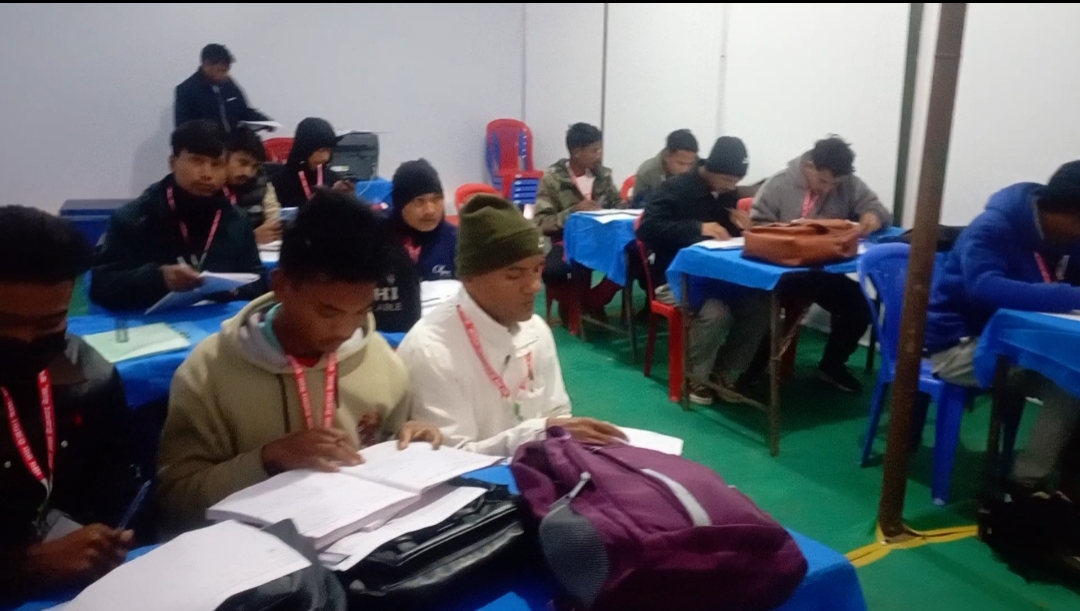
Dhangadhi — Participants in the Skill and Employment Fair organized by the Dhangadhi Sub-Metropolitan City have expressed great enthusiasm. Trainees noted that despite the short duration of the program, they have already gained significant learning opportunities.
“I never thought I could learn my chosen skill in such a short time,” said Rakesh Gharti BK from Lamki Chuha Municipality-1, Kailali. A participant in the woodcraft and furniture training, he added, “I have learned a lot. The practical aspect here is excellent, and I now feel confident that I can start something of my own in my hometown.”
Youth Embracing Traditional Knowledge
Chandradev Bhatt from Adarsha Rural Municipality-3, Doti, who is currently pursuing an MBS degree, is surprisingly training to be a priest (Purohit).
“Astrology and Ritualism (Karmakanda) are our ancient sciences,” Bhatt shared. “This knowledge is fading away. Dhangadhi Sub-Metropolitan City is doing commendable work by providing this training; it preserves our culture and ensures there is no shortage of qualified Brahmins in society.”
Similarly, Khagendra Prasad Upadhyay from Thalara, Bajhang—a second-year BBS student—expressed his gratitude to Mayor Hamal for the opportunity to learn ritualistic traditions alongside his formal education.
From Domestic Skills to Entrepreneurship
Devaki Thapa of Dhangadhi-5 joined the fair with a vision to become a home-based entrepreneur.
Goal: To learn how to make MoMo, Chowmein, and other fast-food items.
Outcome: “Due to a lack of training, my dream remained unfulfilled. Now, the sub-metropolis has made it possible. The instructors teach in a very accessible way,” she said.
Preserving the ‘Sixteen Sanskars’ (Sacraments)
This year, 25 trainees are participating in the priest training program. Over 40 days, they will be taught the nuances of Karmakanda—the religious rituals that govern Hindu life from birth to death.
Why this matters:
Cultural Preservation: In an era where Sanskrit has been removed from government curricula and migration is causing a shift away from ancestral professions, this training fills a vital gap.
The 16 Sanskars: The training covers rituals from conception (Garbhadhan) to naming (Namakaran), marriage (Vivah), and the final rites (Antyesti).
Expert Instruction: Instructor Shastri Prajapati Sharma Awasthi noted that trainees are learning Vedic mantra pronunciation, altar (Vedi) construction, and the preparation of ritual materials.
Program Impact and Scale
The Skill and Employment Fair is becoming a cornerstone of regional development.
Total Trainees 600 participants from across Sudurpashchim Province
Diversity of Skills 22 different types of vocational training
Duration of Priest Training 40 days
Frequency An annual event initiated by the Sub-Metropolis
Nriparaj Upadhyay from Janaki Rural Municipality, who already practices as a priest, summed up the sentiment: “I took over my father’s profession but lacked complete technical knowledge. I am overjoyed that the Mayor provided this chance. If other municipalities did this, it would help many people become self-employed.”